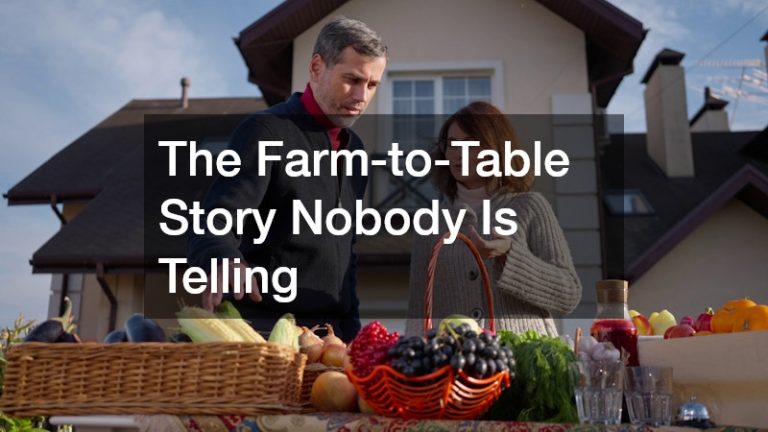
For the last decade, the “Farm-to-Table” movement has been the crown jewel of the culinary world. It’s a narrative we’ve all bought into: the weathered farmer in denim overalls hand-picking heirloom tomatoes, the muddy boots in the back of a vintage pickup truck, and the chalkboard menu listing the exact coordinates of the morning’s harvest. It is a story of intimacy, craft, and a return to a simpler era. But there is a silent revolution happening behind the rustic barn doors—one that the marketing departments of high-end bistros rarely mention. The farm-to-table story no one is telling isn’t about the soil or the seeds; it’s about the silicon.
The Romanticized Mirage
The gap between public perception and agricultural reality has never been wider. In the popular imagination, “small-scale” and “local” are synonymous with “manual.” We want to believe our food is produced through the sweat of a brow and the swing of a scythe. However, the modern food business is facing an unprecedented labor crisis, fluctuating climate patterns, and razor-thin margins. To survive, even the most local, artisanal farms have had to abandon the “Old MacDonald” archetype in favor of high-tech efficiency.
The truth is that the local kale in your $22 salad wasn’t just grown with love; it was grown with data. As the demand for local produce has scaled, the methods used to produce it have had to evolve. The quaint imagery of the past is being replaced by a sophisticated logistics and production engine that looks more like a Silicon Valley startup than a 19th-century homestead.
The Precision Revolution
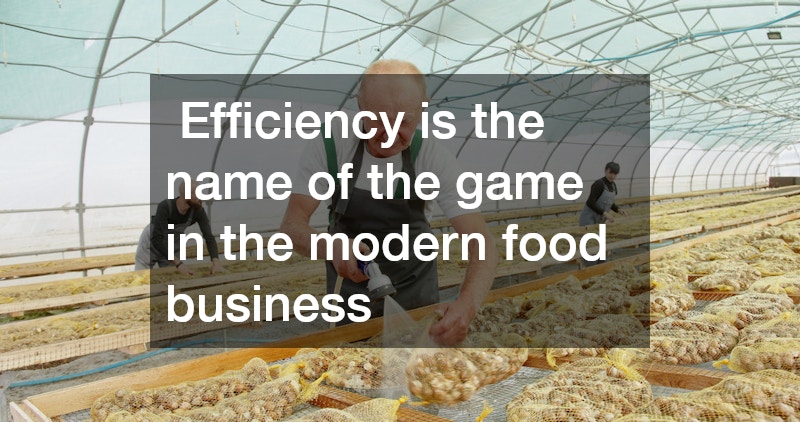
Efficiency is the name of the game in the modern food business. When we talk about sustainability, we often focus on the absence of chemicals, but we ignore the efficiency of the machine. One of the most significant breakthroughs in maintaining the viability of mid-sized farms—the ones that actually supply your local restaurants—is the integration of GPS and automated guidance systems.
Consider the impact of agriculture autosteering. In the past, a farmer driving a tractor would manually steer to keep rows straight, inevitably leading to overlap or gaps. This wasted fuel, time, and seeds. Today, autosteering systems allow tractors to follow pre-programmed paths with sub-inch accuracy. This isn’t just about making the job easier; it’s about precision. It allows for “strip-tilling” and targeted nutrient application, reducing the environmental footprint of the farm while maximizing every square foot of soil. This level of technical sophistication is what allows a local farm to compete with industrial giants while still maintaining the “farm-to-table” ethos.
The Logistics of Locality
The second untold chapter of this story involves the “Table” end of the equation. Moving food from a farm to a restaurant is a logistical nightmare. Industrial food systems are built on massive, centralized distribution centers. Small-scale farm-to-table operations, however, often rely on fragmented networks. To make this profitable, the food business has turned to complex software to manage “last-mile” delivery.
We are seeing the rise of “digital food hubs”—platforms that aggregate produce from dozens of small farms and coordinate delivery to hundreds of urban restaurants. This isn’t a farmer driving a truck to a chef’s back door; it’s a coordinated dance of refrigerated sprinters, real-time inventory tracking, and algorithmic routing. Without this invisible digital infrastructure, the farm-to-table movement would remain a niche luxury rather than a growing sector of the economy.
Why the Silence?
If technology is saving the local farm, why don’t we hear about it? Why do menus focus on the “heritage” of the pig but not the “hectare-mapping” of its feed? The answer lies in consumer psychology. We go to farm-to-table restaurants to escape the digital world. We want to feel connected to the earth, not the cloud. Mentioning agriculture autosteering or automated irrigation sensors ruins the “magic.”
But by hiding the technology, the food business does a disservice to the farmers. It reinforces the idea that farming is a low-skill, nostalgic hobby rather than a high-stakes, high-tech profession. Acknowledging the role of innovation doesn’t make the food less “real.” In fact, it highlights the incredible ingenuity required to bring fresh, local food to a hungry urban population in the 21st century.
It is time to update the farm-to-table story. We should celebrate the fact that a farmer can use satellite data to protect their soil and that a chef can use a blockchain-enabled app to verify the harvest date of their greens. The “story no one is telling” is actually a success story—a tale of how humanity is using its most advanced tools to preserve its most ancient traditions.
The next time you sit down at a restaurant and read about the local farm on the back of the menu, remember that the “purity” of that food is supported by a silent framework of innovation. The muddy boots are still there, but they’re likely stepping out of a tractor cab filled with touchscreens. And that’s a story worth telling.